

Why public MVP cost estimates disagree
Search for MVP pricing and you will find ranges that barely look related. One firm may call a simple web workflow an MVP. Another may include mobile apps, admin tools, payments, analytics, security work, and several months of support.
Recent vendor guides show this spread. ARDURA groups costs by product type and build phase, while EnactOn uses budget tiers based on complexity. Appinventiv, TeaCode, and Designli also describe different ranges because their assumed products and teams differ.
The useful lesson is not the biggest or smallest number. The lesson is that a quote has no meaning until you know what is inside it.
Start with the test, not the feature list
A long feature list makes a budget look detailed, but it can hide the reason the product exists.
Write the risky belief first. It may be that a user will trust a new workflow, pay for a faster result, return each week, or invite a teammate. Then ask what real behavior could prove or weaken that belief.
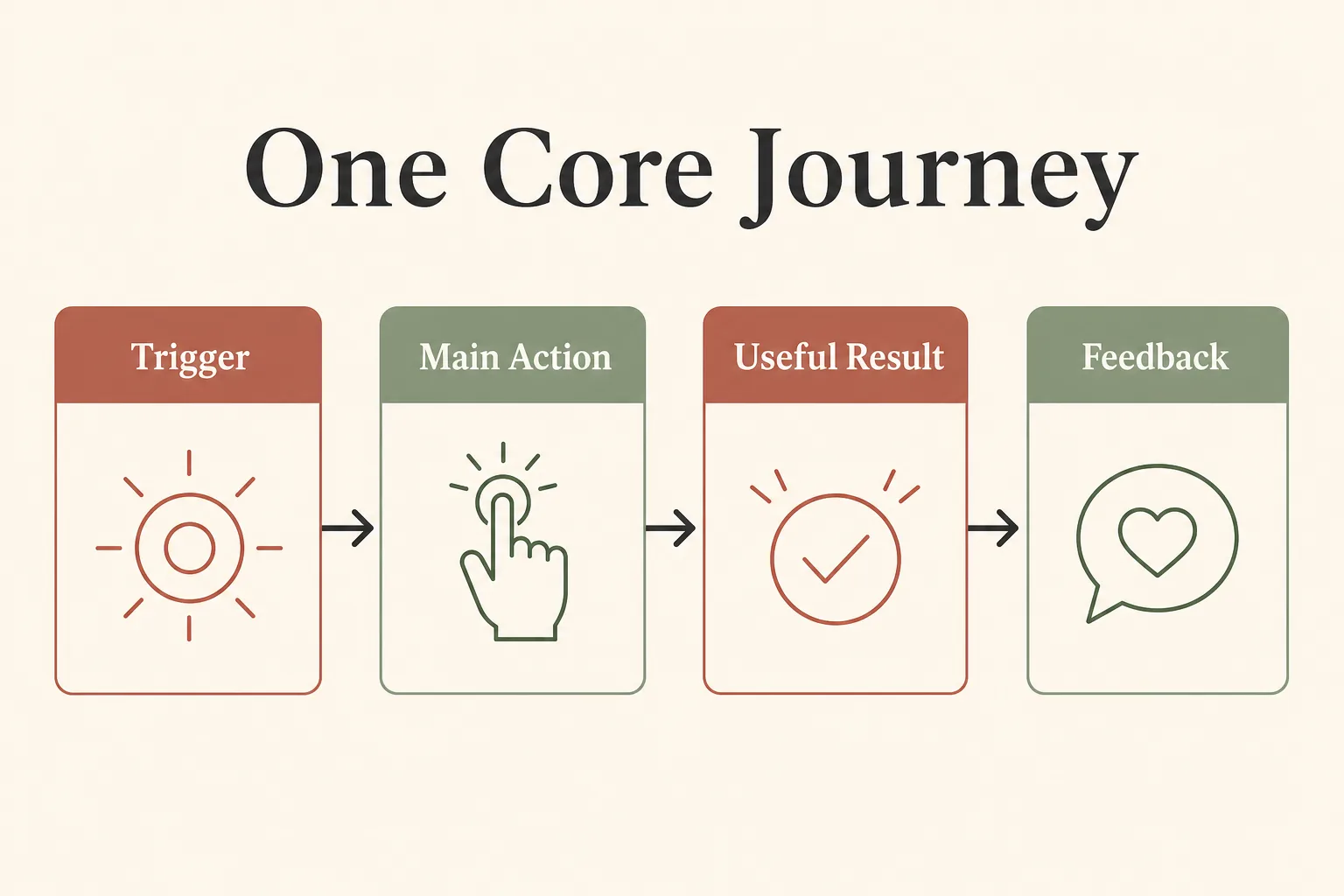
Your first version should support one complete journey from a clear trigger to a useful result. A user should be able to arrive, do the important action, receive value, and give you a signal.
This is different from building many half finished screens. A narrow journey that works can teach you something. A wide product full of placeholders cannot.
If you need help choosing the right test, read our minimum viable product examples. Each example separates the belief, the test, the signal, and the next decision.
Map the full MVP budget before you request quotes
Development is only one part of the budget. A cheap build can still become expensive when discovery, design, testing, launch, or ownership is missing.
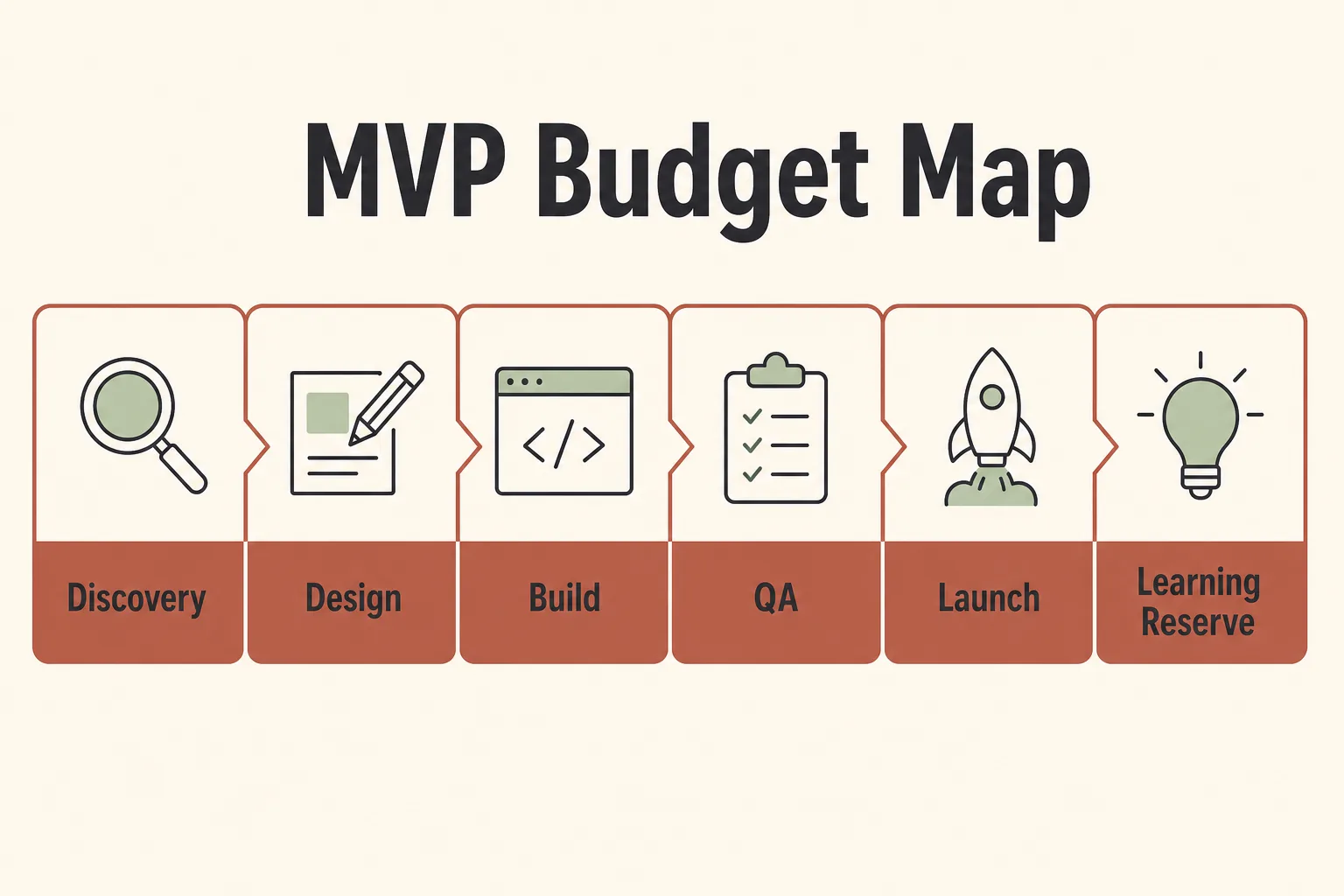
Use six budget stages. Discovery defines the user, risk, and pass rule. Design makes the journey clear before code. Build creates the working product. QA checks the main path and likely failures. Launch puts the product in front of real users. Learning reserve gives you time to fix what the first evidence reveals.
Do not force the same share of money into every stage. A regulated product may need more security review. A new interaction may need more prototype testing. A simple internal tool may need less visual work but stronger data handling.
Ask for a clear output from every stage so you can see what the quote really includes.
| Stage | Key question | Useful output |
|---|---|---|
| Discovery | What must we learn? | Risk, user, scope, pass rule |
| Design | Can users understand the journey? | Flows, screens, clickable test |
| Build | Can the core journey work end to end? | Working product and source code |
| QA | Where can the journey fail? | Test results and fixes |
| Launch | Can real users reach the product? | Live setup, access, analytics |
| Learning reserve | What will we change after feedback? | A planned improvement sprint |
A quote that skips a stage should say who owns that work and when it will happen.
Five choices that change MVP development cost
1. The number of user roles
One customer role is simpler than a product with customers, staff, managers, partners, and administrators. Each role adds permissions, screens, testing, and support cases.
2. The number of platforms
A responsive web product is often a smaller first test than separate web, iPhone, and Android products. Choose the platform where the riskiest users can complete the core journey.
3. The data and integrations
Payments, calendars, maps, messaging, artificial intelligence, and company systems can save time, but they add setup, failure cases, security questions, and ongoing fees.
4. The level of product design
A template can make a common flow faster. A new or trust sensitive journey may need stronger research, clearer writing, accessibility work, and a more careful interface.
5. The level of ownership after launch
Ask who owns the source code, design files, hosting accounts, data, domains, analytics, and technical notes. A low quote with weak handoff can create a larger cost later.
Choose a build path that fits the evidence you need
There is no best build path for every founder. The right path depends on the risk, your own skills, the product, and the quality of evidence you need.
A manual service or simple prototype can test understanding before software exists. A no code product can test a known workflow quickly. An AI assisted custom build can create a focused real product when ownership and flexibility matter. A larger custom team fits products with complex systems, strict compliance, or several connected roles.
Start with the lightest path that can produce honest evidence. Do not choose a cheap path when it cannot test the important risk. Do not choose a large team when a smaller test can answer the same question.
Compare each path by the evidence it can produce, not by price alone.
| Build path | Useful when | Watch for |
|---|---|---|
| Manual service | You need to test demand or delivery | Hidden labor and weak scale proof |
| Clickable prototype | You need to test clarity and flow | No proof that the product works |
| No code build | The workflow uses common patterns | Platform limits and ownership |
| Focused custom build | You need a real core journey and code ownership | Scope control and technical choices |
| Larger custom team | The product has complex systems or rules | More coordination and a larger fixed cost |
A founder can move between paths as evidence gets stronger.
What a healthy MVP project looks like week by week
You should not have to wait until launch day to learn whether your MVP is going well. A healthy project gives you something clear to review at every stage.
After discovery, you should be able to explain the product in a few lines. Name the user, the problem, the one journey that matters, and the result that would make the test worthwhile. Keep the ideas that can wait in a separate list.
During design, click through the full journey as if you were the user. Ask a few people to try it without coaching. Their pauses and questions often tell you more than another planning meeting.
During development, ask to see a working version often. Try it yourself. If a request adds a new screen, rule, or user role, decide whether it helps the current test before it enters the build.
Testing should feel like real use. Create a new account, type the wrong details, lose the connection, cancel a payment, and try the product on the devices your first users own.
Before launch, check that you can reach the code, domain, hosting, analytics, error reports, and backups. Know who will respond if the main journey breaks.
Once people use the MVP, watch where they stop and what they ask. The next budget should follow that evidence. It should not follow the feature request that sounds the most exciting.
How to compare MVP quotes fairly
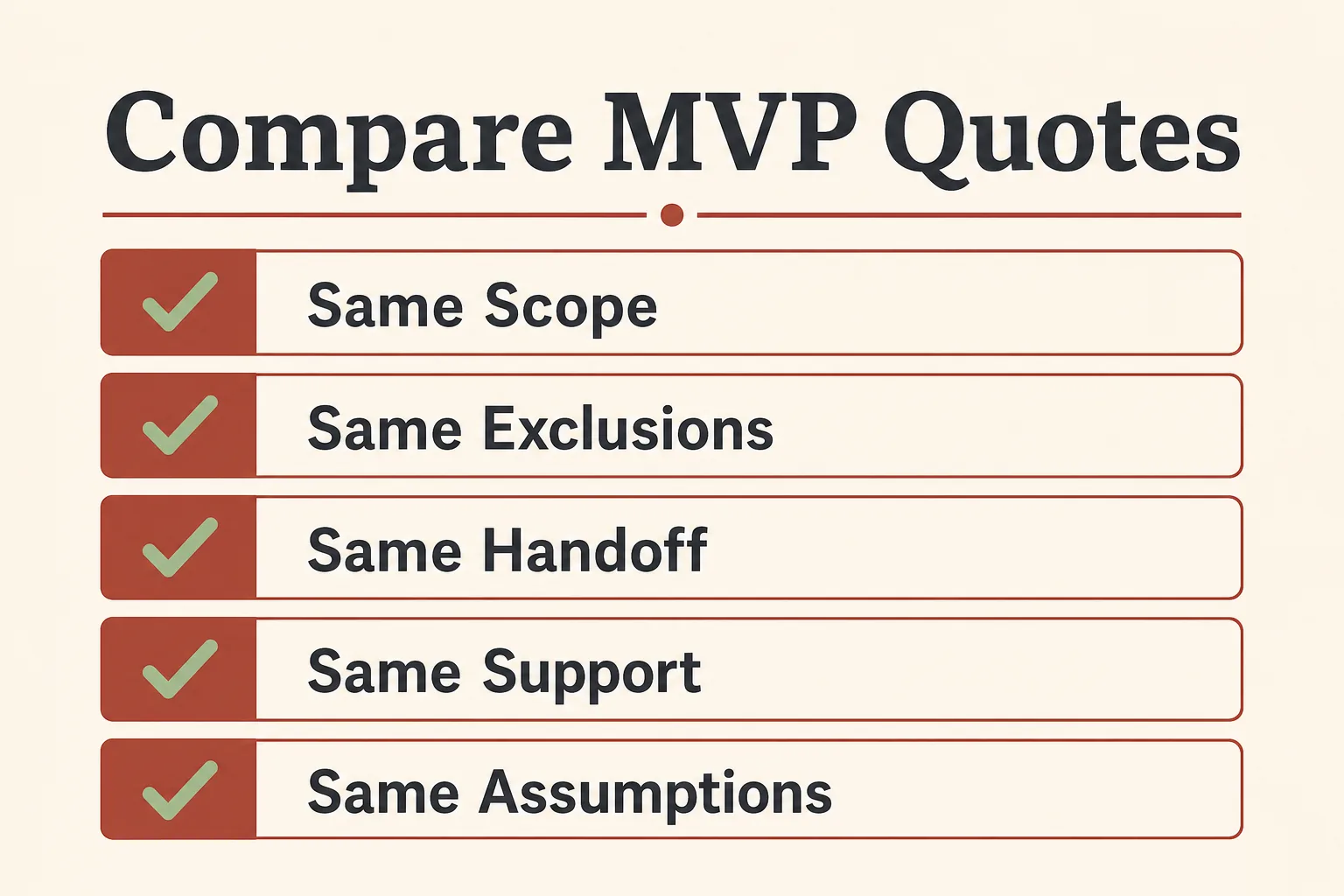
Two quotes can show different prices because they describe different products. Normalize them before you decide.
First, give every team the same one page brief. It should name the user, problem, core journey, required integrations, pass rule, deadline reason, and what can wait.
Next, ask each team to list assumptions and exclusions. One team may include discovery and QA. Another may expect you to provide final screens, product copy, test data, and hosting.
Then compare the handoff. Confirm source code access, design files, account ownership, deployment notes, and the support window. Ask how changes are priced when a user test reveals a problem.
Finally, compare the team and plan. Who will do the work? Who reviews it? How often will you see a working version? What happens when a required integration fails?
The lowest number is useful only when it buys the same outcome.
Questions to ask before you sign
- What exact user journey will work at launch?
- Which features and platforms are outside this quote?
- Who owns code, design files, accounts, and data?
- What testing is included, and on which devices?
- What support is included after launch?
- How will scope changes be approved and priced?
- What evidence should this MVP produce?
Red flags in a very cheap or very expensive quote
A very cheap quote may leave out discovery, QA, deployment, security, or handoff. It may also rely on a template that does not fit the core journey. Ask for a working breakdown before assuming it is a bargain.
A very expensive quote may include scale, automation, platforms, and polish that the first test does not need. Ask which parts directly support the risky belief.
Be careful when a team promises funding, guaranteed growth, or a perfect first launch. A good MVP reduces uncertainty. It does not remove it.
Build a founder budget in 30 minutes
Open a blank page and answer these questions in order.
- Who is the first user?
- What painful job are they trying to finish?
- What belief could make the idea fail?
- What one journey can test that belief?
- What must work inside that journey?
- What can stay manual for now?
- Which account, data, and integration do you need?
- What behavior will count as useful evidence?
- Who owns launch and support?
- What will you reserve for the first changes?
Turn the answers into a one page brief. Use the same brief with every team. If a quote adds work, ask why that work is required for the test.
Our guide to MVP development for startups explains how to protect the learning goal while you move from idea to a working product.
A useful MVP budget buys learning
The right budget is not the smallest number and not the largest product. It is the smallest responsible investment that can produce evidence you trust.
Define the belief. Build one complete journey. Make every quote describe the same work. Keep enough time and money to act after launch.
That is how MVP development cost becomes a decision tool instead of a guess.
Frequently asked questions
What is included in MVP development cost?
A complete budget may include discovery, user flows, product design, development, QA, deployment, analytics, handoff, and a short improvement period. Always ask the team to list included work and exclusions.
Why do MVP quotes vary so much?
Quotes use different assumptions about features, platforms, user roles, integrations, design depth, security, team size, support, and ownership. Compare the same scope before comparing price.
Can I build an MVP without custom code?
Yes, when a manual service, prototype, or no code tool can produce honest evidence. Custom code becomes useful when the core journey, ownership, integrations, or product rules need more control.
What should I leave out of the first MVP?
Leave out work that does not help the core user complete the main journey or help you test the risky belief. Common later items include extra roles, secondary platforms, advanced reports, deep automation, and broad settings.
How much budget should remain after launch?
Keep a learning reserve that can cover user research, urgent fixes, and the first evidence based changes. The right amount depends on the product risk and support needs, so it should be planned rather than guessed.
How can I reduce MVP development cost safely?
Reduce the number of roles, platforms, integrations, and secondary journeys. Use existing services for common needs. Test unclear ideas with a prototype before code. Do not cut ownership, essential security, QA for the main journey, or the ability to learn after launch.