

What makes a useful MVP example
Many startup stories show the small product but hide the thinking behind it. That makes the story fun to read and hard to use.
A useful example has five parts:
- The riskiest assumption
- The smallest honest test
- What the team left out
- The real behavior it measured
- The next decision the evidence supported
The last two parts matter most. A simple page is not an MVP when it teaches you nothing.
Do not copy the surface of a famous test. Copy its logic.
Use evidence that is hard to fake
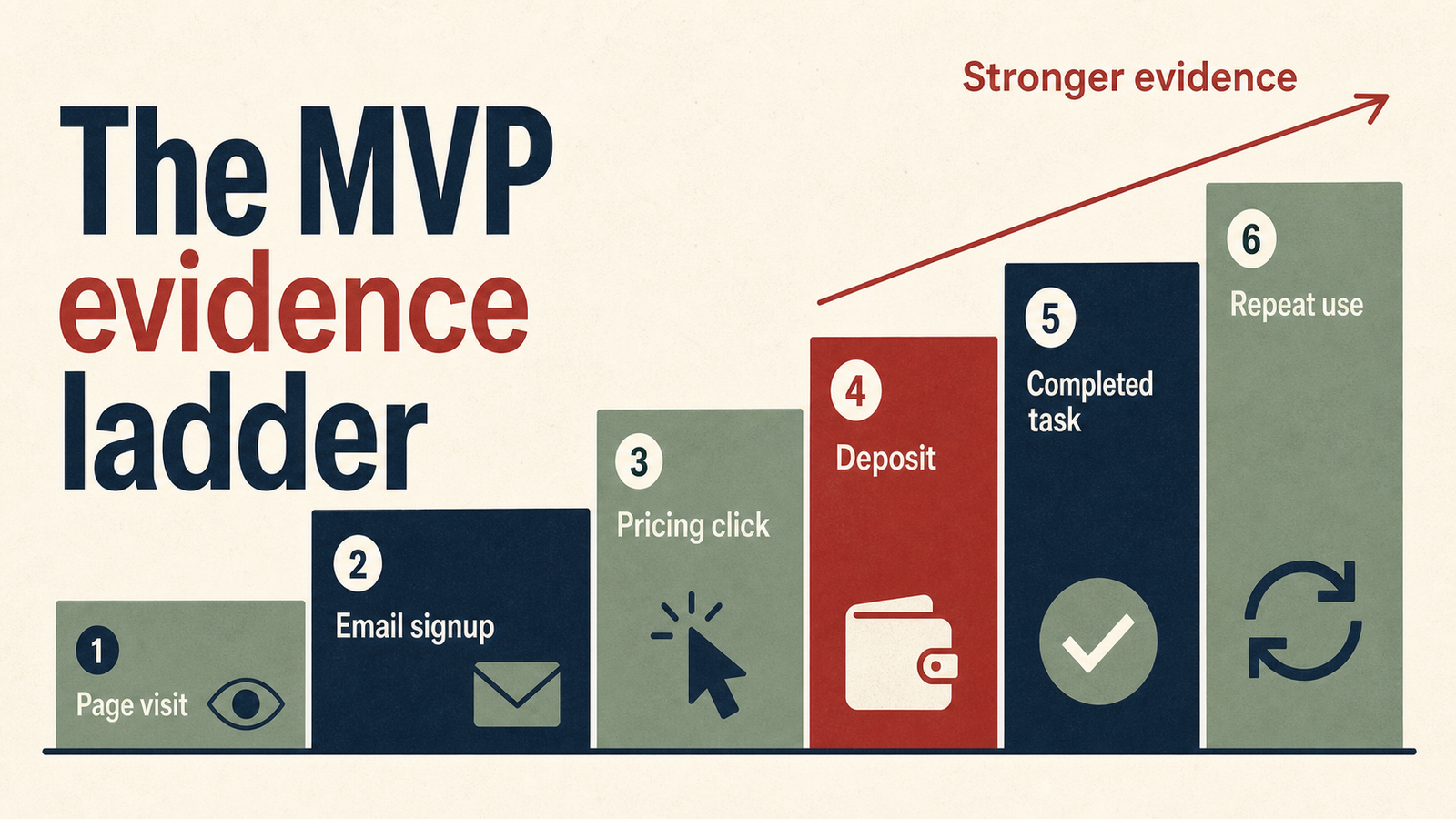
Not every signal has the same value.
A page visit shows interest in a topic. An email shows that a person wants to hear more. A pricing click shows that price did not end the journey at once.
A deposit, completed task, or repeat use asks for more effort. That normally gives stronger evidence.
The right signal depends on the question. A short comprehension test can check a message. Polite praise cannot prove demand.
Set a pass rule before the test. For example, you may decide to continue only if five of twenty invited users finish the main task without help.
Minimum viable product example 1: Dropbox tested understanding with a video
Dropbox needed people to believe that file sync could feel simple. Building a complete version for every device would take time, and a plain description was hard to trust.
The team made a short product video for early users. The video showed the intended experience in a way that the right audience could understand.
It left out the scale and broad device coverage of a mature product. The useful signal was whether the right people wanted access after seeing the workflow.
The waitlist showed interest, not proof of long term use. The next step was a working product that could test daily trust.
TechCrunch documented the early Dropbox demo and the response it received.
Lesson: use a video when the main risk is whether people understand and want a hard product idea. Do not treat video views as proof that the product works.
Minimum viable product example 2: Buffer tested demand before the product
Buffer began with a very small page that explained scheduled social posts. A button led visitors to a message saying the product was not ready.
That first test asked whether the problem and promise were clear enough to earn a click. A later version added pricing choices before the product existed.
The team left out account connections, scheduling tools, billing, and the many controls a full social product would need.
Plan clicks were stronger than visits. They did not prove that people would pay or return.
Buffer founder Joel Gascoigne explained the path from the first page to paying customers.
Lesson: a landing page can test demand in layers. Test the message first, then price interest, then payment, then repeat use.
Minimum viable product example 3: Zappos tested online shoe buying by hand
The early Zappos idea faced a basic question. Would people buy shoes online without trying them on?
The founder photographed shoes in local stores, placed the images online, and bought a pair after a customer ordered.
This left out owned stock, fast operations, and strong margins. It kept the customer journey needed to test a real purchase.
A paid order proved demand, but the manual process could not prove the business would work at scale.
An early Inc. profile of Zappos describes the company history and the hard work behind the model.
Lesson: when supply risk is high, serve a few real orders by hand. Measure both customer demand and the hidden work required to deliver.
Minimum viable product example 4: Airbnb tested a narrow stay
Airbnb began with a very narrow offer. The founders hosted guests in their own home when local demand made hotel rooms hard to find.
They did not build a global marketplace, trust system, host network, or full travel brand first. They tested whether strangers would book a simple place to stay through the internet.
The strongest signal was a completed stay. Guests had to choose the offer, pay, arrive, and accept the experience.
One city and one event could not prove regular demand or trust at scale.
Airbnb says its first two hosts welcomed three guests in 2007.
Lesson: narrow the place, time, and audience when a marketplace feels too large to test. Keep the full customer outcome inside the small test.
Minimum viable product example 5: DoorDash tested delivery with simple tools
DoorDash started as Palo Alto Delivery. The founders used a basic website, a phone number, and menus from local restaurants.
They did the delivery work themselves. This let them see whether customers would order and whether a small team could complete the journey.
The test left out driver software, route systems, and a large restaurant network.
A completed paid delivery tested demand and operations. It also exposed the work hidden behind the idea.
DoorDash later wrote that the founders were the first delivery drivers and used simple tools to coordinate the work.
Lesson: do the service by hand before you automate it. Manual work can show which software deserves to exist.
Minimum viable product example 6: Product Hunt tested a daily habit with email
Product Hunt began as a simple way for a small group to share new products. Founder Ryan Hoover first used an existing group email tool instead of building a public platform.
The early test left out profiles, votes, comments, collections, and the large community that came later.
The key question was whether a focused group would keep sharing and opening a fresh list.
Repeat participation mattered more than one busy day. An invited founder group could still behave differently from a public audience.
In a founder interview, Hoover described setting up the first email list in minutes.
Lesson: test a repeated habit with tools that already exist. Build custom software after the behavior becomes clear.
Minimum viable product example 7: Groupon tested group deals with a simple publishing flow
Groupon grew from a simple daily deal process. Early offers could be posted without building the large merchant, payment, and discovery system people later knew.
The main risk was whether enough people would act on one local offer. A focused deal made that easier to see.
The early process left out broad merchant tools and complex campaign controls.
A purchase was strong evidence. One popular deal could still hide weak repeat demand.
Lesson: when a marketplace has two sides, test the smallest complete trade. Measure the buyer result and the supplier result before adding more categories.
Minimum viable product example 8: Amazon started with one clear category
Amazon had a large vision for online retail, but it began with books.
Books gave the team a clear product type, a known catalog, and a strong reason to shop online. A website could offer far more titles than one physical store could hold.
The narrow start left out the many categories and services that came later.
Completed orders and repeat purchases tested whether online book shopping could become a habit.
Amazon’s first shareholder letter says the company began by serving customers with books.
Lesson: a large product vision does not require a broad first release. Choose one category where the online value is easy to understand.
Minimum viable product example 9: Foursquare focused on the check in
Foursquare made location sharing easy to understand through one core action: checking in at a place.
The focused product did not need to begin as a full local search engine, travel guide, ad network, and location data business.
The main behavior was simple. Would people mark where they were and return to do it again?
Repeat check ins showed a social habit. A fun action can still fade when the new feeling passes.
Founder Dennis Crowley described the early location and check in idea.
Lesson: one repeated action can reveal the heart of a social product. Track retention, not only first week excitement.
Choose the test by the riskiest question
Do not start by asking which famous MVP you should copy. Ask which belief has the least evidence.
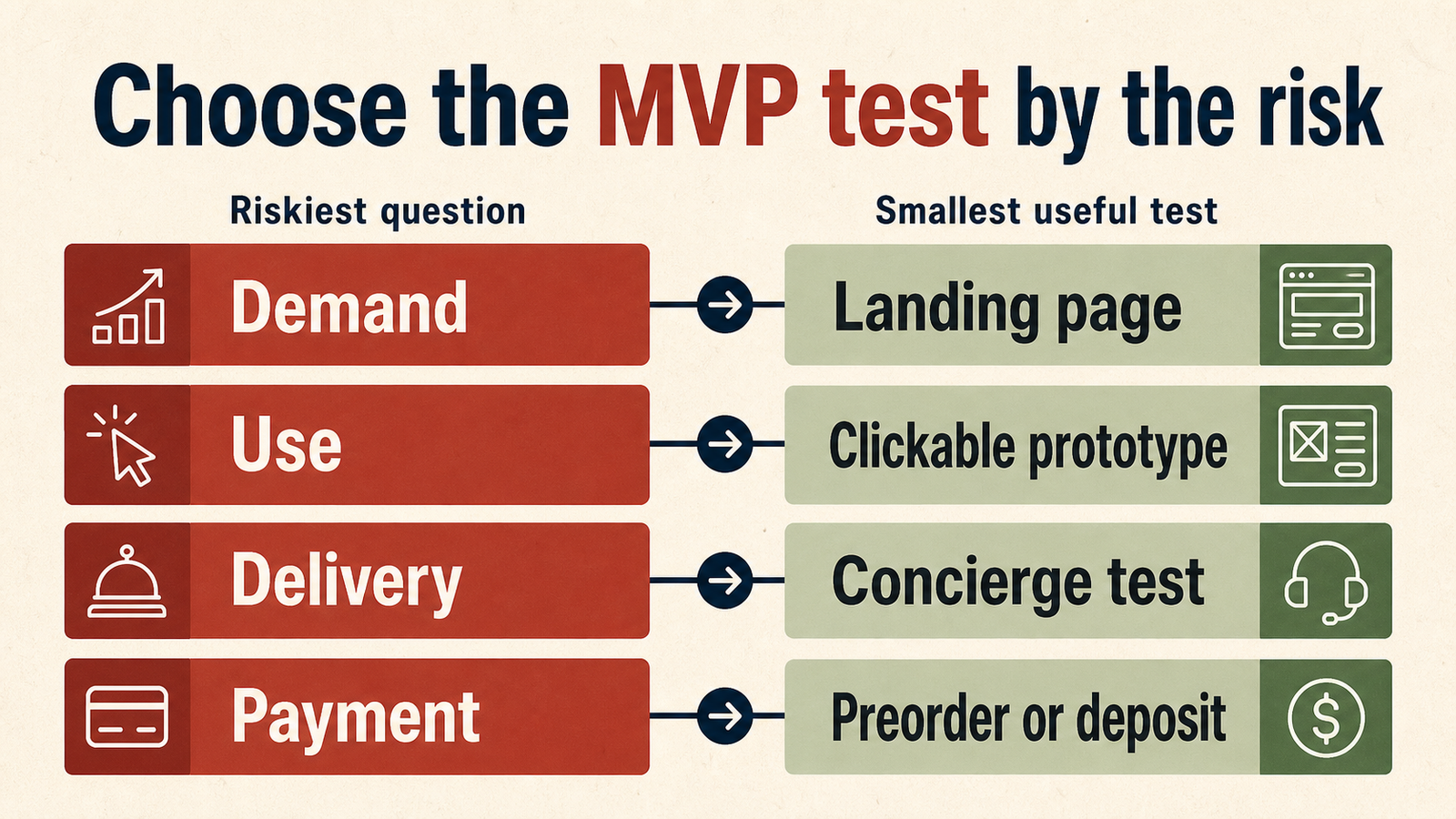
Use a landing page when the risk is demand or message clarity. Use a clickable prototype when the risk is whether a person can follow the core journey.
Use a concierge test when the result matters more than the software. Deliver the result by hand and record every step.
Use a preorder or refundable deposit when polite interest is common and willingness to pay is the real question. State clearly what exists, what does not exist, and what the buyer will receive.
Do not collect money for a promise you cannot honor. An MVP is small, not misleading.
Write the test before you build it
Use this sentence:
Now write what a failed test means. Will you change the audience, the problem, the offer, the price, or the delivery method?
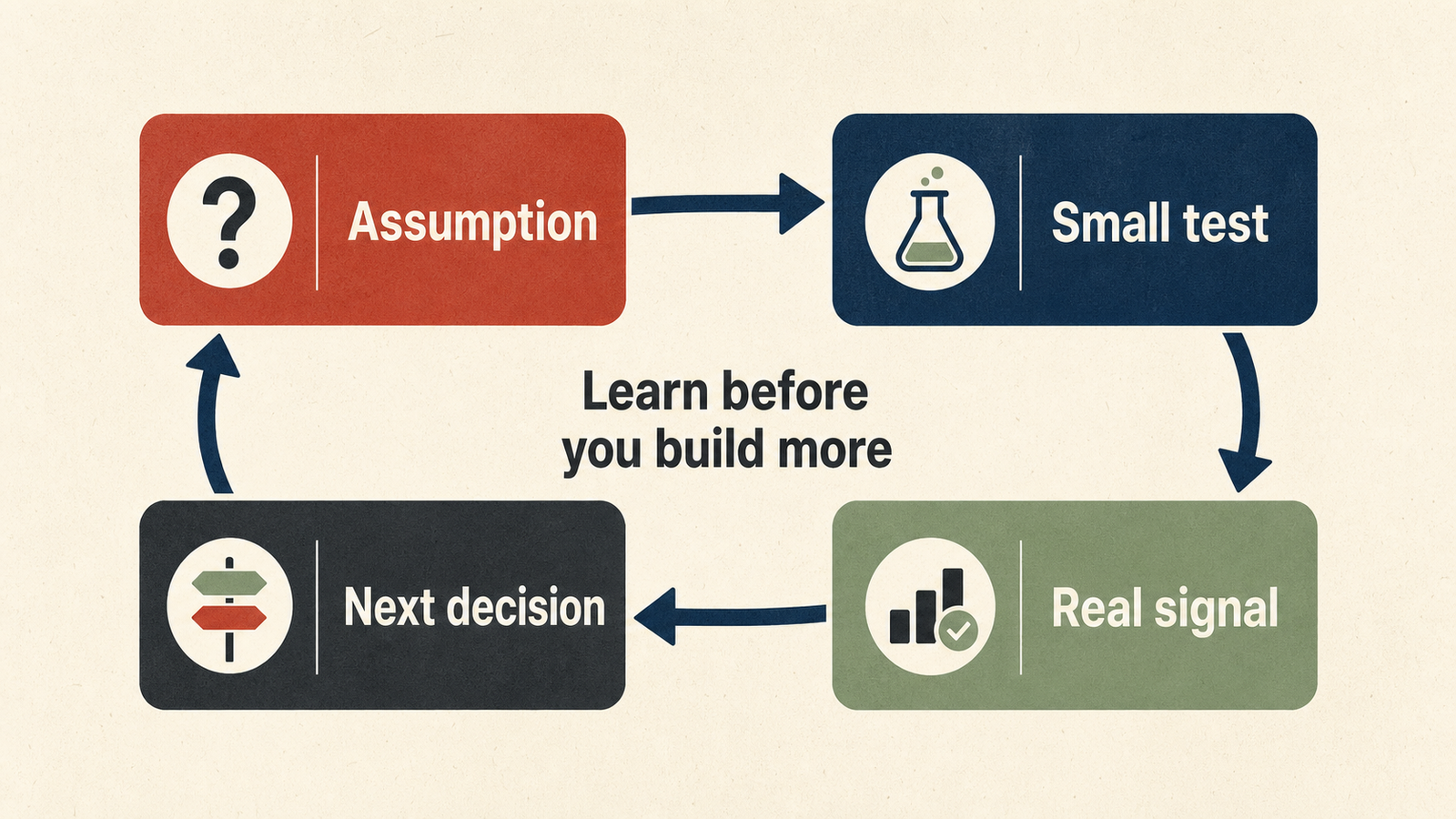
Keep the test tied to one decision. When one test changes the message, price, product, and audience at the same time, you will not know which change caused the result.
Run the smallest useful version. Watch people use it. Record where they stop, ask for help, pay, return, or leave.
Then decide. Stop when the problem is weak. Change the test when the signal is unclear. Build the next part when the evidence supports it.
We believe [specific user] will take [real action] to solve [specific problem]. We will continue if [pass rule] happens by [review date].
What not to copy from famous MVP stories
Do not copy the result without copying the test condition. Event demand helped Airbnb. A founder network helped Product Hunt. Those conditions shaped the early signal.
Do not call a broken product an MVP. The core promise still needs to work. A food delivery test must deliver the food. A booking test must honor the booking.
Do not treat press, followers, or compliments as customer evidence. Ask for an action that costs time, effort, trust, or money.
Payments, health, finance, privacy, and safety may need strong controls even in an early test.
When should you build the real product?
Build more when the current test answers its question and the next risk needs working software.
For Dropbox, a video could test interest, but only a working sync product could test daily trust. For DoorDash, manual delivery could expose the steps, but software became useful when order volume made coordination hard.
Move from manual work to software when the same task repeats, the process is understood, and automation will improve the customer result.
If you are planning a software MVP, our guide to MVP development for startups explains how to choose the core journey, cut extra features, and plan useful evidence.
When you need design and engineering support, review our MVP development service and bring the assumption, test, and pass rule with you. That keeps the project focused on learning, not feature count.
Frequently asked questions
What is a minimum viable product example?
A minimum viable product example shows the smallest honest test a team used to learn about a risky business belief. It should explain the assumption, test, real behavior, limits, and next decision.
What is the best example of an MVP?
There is no single best example. Dropbox is useful for testing interest in a hard technical idea. DoorDash is useful for testing a service by hand. Buffer is useful for testing message and price interest in stages. Choose the example that matches your risk.
Can a landing page be an MVP?
Yes, when the question is whether the right people understand the offer and take a clear next step. It cannot prove that the product works or that people will keep using it.
Does an MVP need working code?
No. A video, clickable prototype, manual service, or existing tool can test some assumptions. Working code is needed when the main question depends on real product behavior, speed, trust, or repeat use.
How many features should an MVP have?
Use the fewest features needed to complete one useful customer journey and test one main risk. Feature count is less important than whether the core promise works.
How long should an MVP take to build?
The answer depends on the risk, product, and safety needs. Start with the smallest test that can guide a real decision. A message test may take days. A secure working product may take much longer.
How do I know if an MVP test passed?
Choose a pass rule before the test. Use behavior that fits the question, such as completed tasks, deposits, paid orders, repeat use, or correct understanding. Compare the result with the rule and record what you will do next.
What happens after an MVP succeeds?
Test the next biggest risk. Improve the weak part of the journey, build the software needed for repeated work, and check whether people return. Success in one test is permission to learn more, not proof that every part of the business will work.