

What startup company branding must solve
A logo can help people recognize you. It cannot decide what your startup should mean.
Good startup company branding answers three simple questions: Who is this for? What useful change do we create? Why should a buyer believe us?
If the answers are vague, design only makes the confusion look polished. If the answers are clear, even a small visual system can feel steady and trustworthy.
A short fictional example
Think about a fictional founder named Maya. She is building an inventory alert tool for small online shops.
Her first message says, “AI-powered commerce intelligence for modern brands.” It sounds impressive, but shop owners do not know what the product does.
During five short customer talks, Maya hears the same worry: “I need to know what will run out this week.” She changes the message to, “See which products may run out before your next order.”
The product did not change. The value became easier to understand.
Make five decisions before designing a logo
Brand design moves faster when the founders agree on the hard choices first.
1. Choose one main audience
Do not begin with “everyone who needs our product.” Pick the group with the clearest and most urgent problem.
Write down what that group does, what triggers the search for help, and what words they already use.
2. Name the problem in customer language
Founders often describe features. Buyers describe the moment that hurts.
“Automated inventory analytics” is a feature. “I keep selling products that are already out of stock” is a problem a buyer can recognize.
3. Make one useful promise
State the result the startup helps create. Keep it specific enough to understand and honest enough to support.
Avoid words such as revolutionary, world-class, seamless, and cutting-edge. These words do not explain what changes for the customer.
4. Decide how the brand should sound
Pick three useful voice traits. For example: clear, calm, and practical.
Then name three traits to avoid. Maya may choose not to sound technical, playful, or dramatic. This gives writers and designers a real boundary.
5. Choose the next action
Every main page should help the right person take one clear step. That may be joining a waitlist, trying a demo, booking a call, or starting a trial.
Your brand message and visual hierarchy should make that step easy to notice.
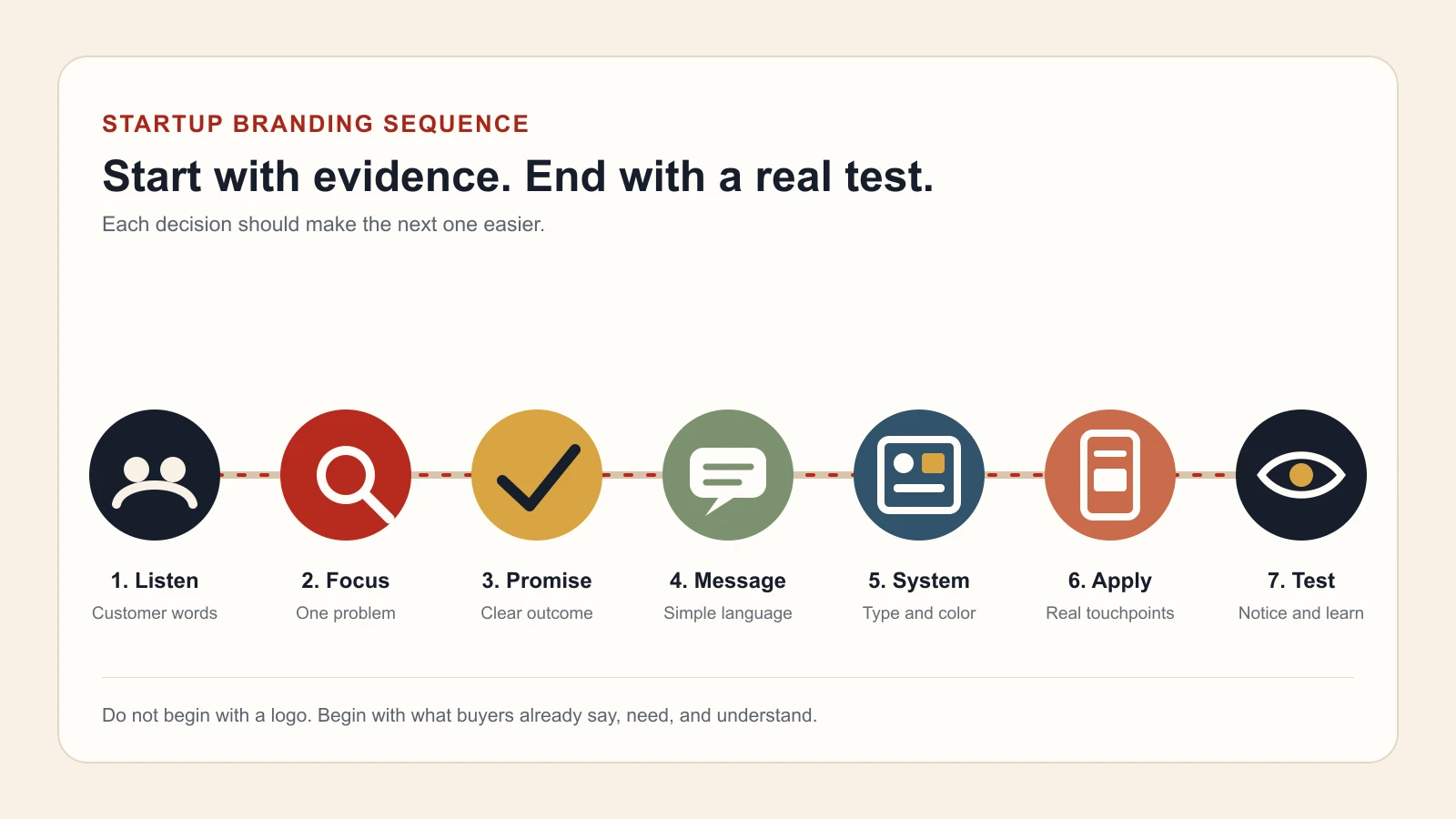
Build a minimum viable brand for your stage
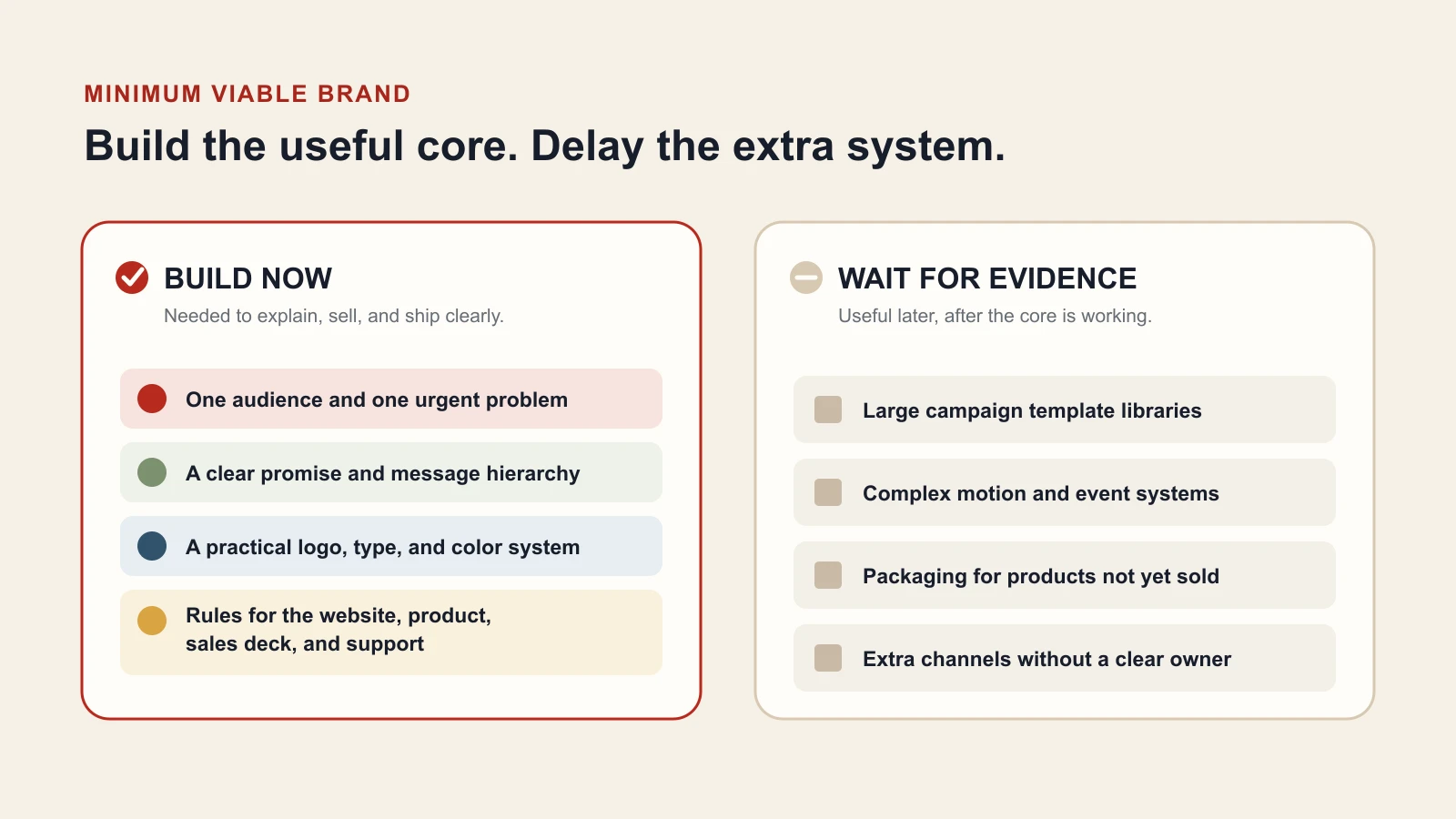
A minimum viable brand is the smallest clear system your startup can use without looking careless or changing direction every week.
It is not a cheap logo pack. It is a short set of decisions that helps the team speak and design with one voice.
The exact scope depends on where customers meet the startup. A software company may need product interface rules early. A physical product may need packaging sooner.
The goal is not to make every possible asset. The goal is to make the current customer journey feel connected.
The useful core normally includes
- One primary audience
- One clear problem
- One promise
- A short message hierarchy
- A practical logo
- A type and color system
- Examples for the website, product, and sales deck
- Basic rules for voice, spacing, images, and ownership
Test positioning with real customer language
Positioning means the place you want the startup to hold in a buyer’s mind. You can test the message before paying for a large identity system.
Talk to recent buyers, active prospects, or people who have the problem. Ask about the last time it happened.
Do not ask, “Do you like this idea?” People often try to be polite. Ask about real behavior and real words.
Write down repeated phrases. Then test a simple statement.
Show the statement without explaining it. Ask what the person thinks the startup does, who it is for, and what they would expect next.
If the answer is wrong, fix the message before adding more design.
Questions that uncover useful language
- What were you trying to do?
- What made the problem urgent?
- What did you try first?
- What felt slow, risky, or confusing?
- How would you explain the problem to a coworker?
We help [specific user] do [important job] without [painful alternative].
Decide what to build now and what can wait
Every asset should pass one of three tests.
Build it now if the customer journey fails without it. Learn first if the decision depends on behavior you have not seen. Place it later if it improves a system that is already working.
This rule protects time and budget. It also keeps the design team from building a large system around a message that may still change.
A pre-launch software startup may need a landing page, product screens, a pitch deck, and a small social set.
It may not need event graphics, a large illustration library, or dozens of campaign templates.
When you need a budget range, use the separate guide to professional branding costs for a tech startup. It explains scope without forcing one price onto every stage.
Create a one-page founder branding brief
A useful brief makes decisions visible. It should help a designer understand the business without reading a long company history.
Co-founders should review the page together. Mark any answer they describe differently.
Those differences are not small writing issues. They are brand decisions that need agreement before visual work begins.
Keep these points on one page
- Primary audience
- Urgent problem
- Main promise
- Reason to believe
- Main customer words
- Three voice traits
- Three traits to avoid
- Priority touchpoints
- Required next action
- Final decision owner
Choose DIY, AI tools, a freelancer, or an agency
There is no single right way to build startup company branding. Choose based on risk, speed, skill, and the number of people who must use the system.
| Option | Best fit | Main strength | Main risk |
|---|---|---|---|
| DIY | Very early idea with one founder and few touchpoints | Fast learning with low outside cost | Choices may become inconsistent |
| AI tools | Exploring directions, organizing notes, or making early options | Helps create and compare starting points | Generic output and weak decisions without human direction |
| Freelancer | A focused launch with a clear brief and one main owner | Specialist help with a direct working relationship | Scope can break when the brief keeps changing |
| Agency | A bigger launch, several teams, or many customer touchpoints | Research, strategy, design, and rollout can stay connected | Requires more time, access, and investment |
AI can help sort notes, test wording, and create rough directions. It should not invent customer evidence or make the final business choices.
Apply the brand to the whole customer journey
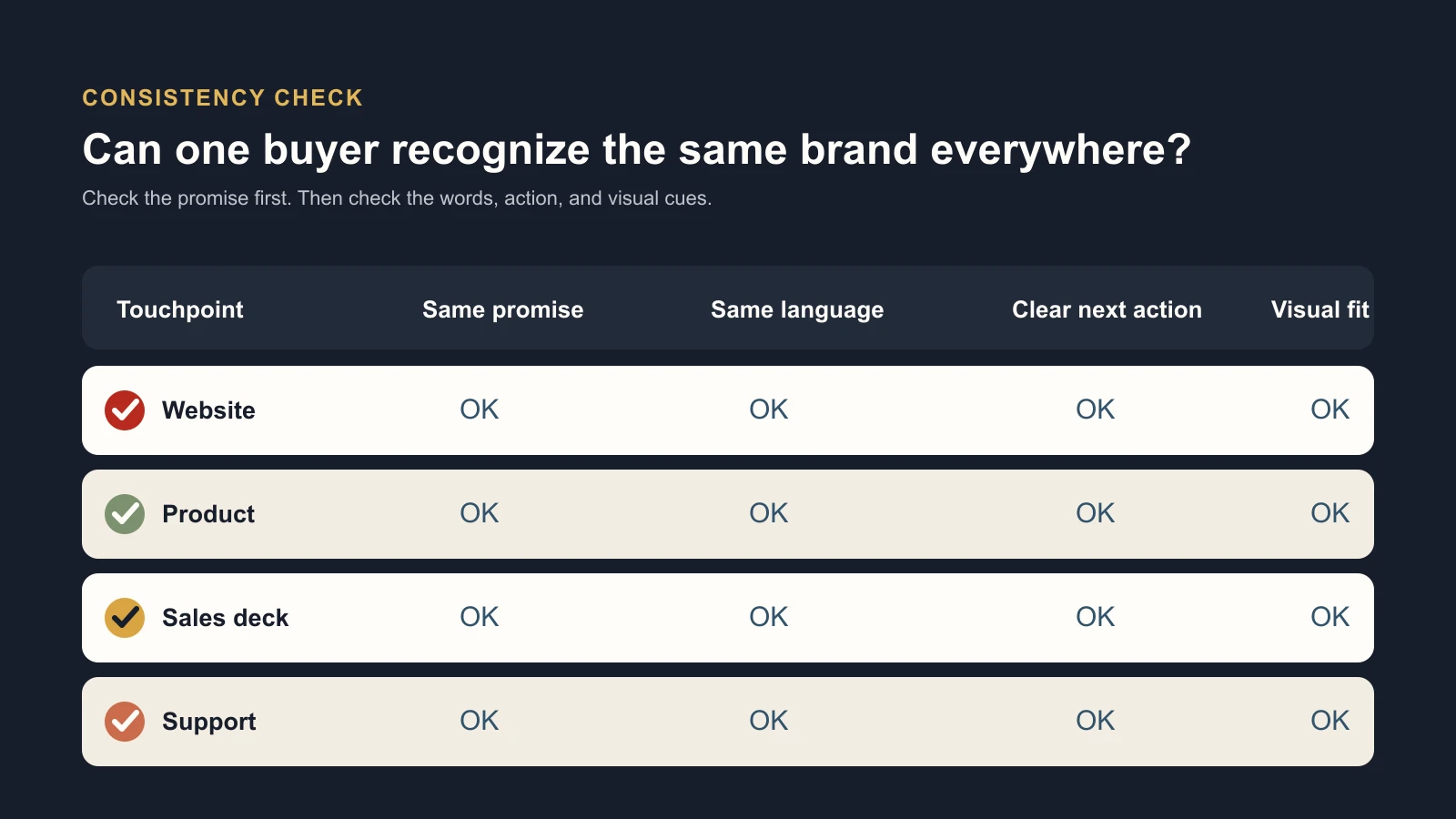
A brand becomes real when people experience the same promise across different moments.
On the website, the headline should explain the value. In the product, onboarding should help the user reach that value.
In the sales deck, the story should use the same problem and promise. Support messages should also sound like the same company.
A warm website followed by cold, technical support creates doubt.
Use the brand identity design process when you are ready to turn the brief into a working visual and verbal system.
Color and type must also work in real interfaces. The W3C guidance on color contrast explains why text, icons, buttons, and other useful elements need enough contrast to remain clear.
Measure whether people understand and remember the brand
Do not begin with likes or compliments. Begin with understanding.
Show the homepage to a person who fits the audience. After a short look, hide it and ask three questions.
What does this company do? Who is it for? What should you do next?
Track wrong guesses and repeated questions. These clues show where the message or hierarchy is weak.
Listen for the words people use when they describe the startup to someone else. If their words match the intended promise, the brand is becoming easier to remember.
Also check whether the same message appears in sales calls, product onboarding, and support.
A system that only works on the homepage is not yet a working brand.
Fix warning signs before spending more
Do not solve every warning sign with a redesign. Sometimes the message needs work. Sometimes the team needs fewer options and a clearer owner.
Change the smallest part that caused the problem. Test it again before rebuilding the full system.
Pause and review when
- Co-founders explain the startup in different ways
- Buyers keep placing the product in the wrong category
- The homepage leads with features but hides the result
- The visual identity looks close to several competitors
- Each channel uses a different tone
- The team cannot find or apply the brand rules
- The logo works, but the product and website feel unrelated
- Important text or controls are hard to read
Startup company branding checklist
You do not need a huge brand book to pass this check. You need clear choices that your team can use.
Before launch, confirm that
- The main audience is specific
- The urgent problem uses customer language
- The promise is clear and supportable
- The startup can explain why it is different
- The voice has useful boundaries
- The visual system works in real product and website screens
- The next action is easy to find
- The team uses the same message across major touchpoints
- Every important asset has an owner
- Real people can explain the startup after a short look
Frequently asked questions
What is startup company branding, and how is it different from a logo?
Startup company branding is the full system that shapes what people understand, feel, and remember. A logo is one visual part of that system. The brand also includes audience, promise, message, voice, colors, type, images, and customer experience.
When should a startup begin branding?
Begin when you can name the customer problem and need to explain the startup to other people. Start small. Learn from customer language before investing in a large identity system.
Does a startup need branding before building an MVP?
It needs basic clarity, not a complete brand system. Define the user, problem, promise, and simple voice before the MVP. Add the visual assets needed to test and present the product clearly.
What should a minimum viable brand include?
Include one audience, one problem, one promise, a message hierarchy, a practical logo, type and color choices, voice rules, and examples for the main customer touchpoints. Add more only when real use shows a need.
How can founders test positioning before paying for design?
Use real customer interviews and repeated customer words. Show a simple promise without explaining it. Ask what the startup does, who it serves, and what the person expects next. Fix wrong guesses before expanding the design.
How much should a startup spend on branding?
There is no useful fixed amount for every startup. Cost changes with research, number of touchpoints, team size, and the depth of the system. Pay first for the decisions and assets that support the current launch.
Should a startup use AI tools, a freelancer, or an agency?
Use AI for organized exploration, a freelancer for focused execution, and an agency when research, strategy, design, and rollout must work across several teams or touchpoints. The right option depends on the risk and scope.
How can a startup measure whether its branding works?
Check whether the right people can explain what the startup does, who it is for, and what action to take. Watch for fewer wrong guesses, more consistent customer language, and the same promise across the website, product, sales, and support.